Workspace
Where your team and agents
do the work, side by side

Compile the Q2-to-date attribution package. IC review is Friday, and they want the writeup and the underlying numbers in one place.

Pulling the attribution rows from Snowflake and the factor scorecards. Going to ship a .docx + .xlsx pair.
- Pull daily attribution Q2 to date, 104 rows
- Compute factor & sector decompositions, Snowflake
- Compose writeup, 3 sections
- Render spreadsheet, attribution sheet
- Wrote factor-decay-2026-05-26.docx, 84 KB
- Wrote p&l-attribution-may-w22.xlsx, 412 KB
Package ready. Writeup in the .docx; underlying numbers in the .xlsx with one tab per factor.
factor-decay-2026-05-26.docx84 KB · for IC reviewp&l-attribution-may-w22.xlsx412 KB · 8 factor tabsThe momentum decay row needs context. Footnote the schema-pin patch underneath.
Footnote added. Cites incident-2026-05-26 + PR #4181 + the vendor-schema-drift-watch rule. Both files updated in place.
Q2 attribution
Package ready. Writeup in the .docx; underlying numbers in the .xlsx with one tab per factor.
Footnote added. Cites incident-2026-05-26 + PR #4181 + the vendor-schema-drift-watch rule. Both files updated in place.
What was checked
Pull daily attribution (Q2 to date): 104 rows
Compute factor & sector decompositions: Snowflake
Compose writeup: 3 sections
Workspace is where people and agents complete tasks together, on the same files in the same environment. Skills define the work in plain English, and every action becomes a trace your team owns.
Plain-English skills
One surface for people and agents
A trace on every run
Side by side
People stay in control
A person and an agent work the same task in the same place. The agent does the legwork; the human approves the calls that matter.
- Live cursors and shared files, so a handoff is a glance, not a re-brief.
- Sensitive actions wait for a person; routine ones run on their own.
- Every step is on the record, so review is reading, not reconstructing.
Reviewing 12 strategic accounts to flag ARR at risk this quarter.
Built for work, not just chat
The surface carries the whole job, from the skill that defines it to the trace it leaves behind.
Plain-English skills
Anyone can describe a workflow in plain English. It becomes a durable team artifact others can run, inspect, and improve.
A computer per agent
Each agent gets its own sandboxed environment to run commands, navigate files, and execute code, not just a chat box.
The same files
People and agents work the documents, sheets, and decks together, with a clean handoff in either direction.
Any model or agent
Claude, GPT, Gemini, Kimi, or open weights. Bring your own agent framework, or use ours.
A trace on every run
Every action is captured as a complete, replayable trace, so the work is auditable by the team accountable for it.
Applets for the task
Agents generate a fit-for-purpose interface for a workflow, so the team works in the view the task needs.
Model-agnostic
Use any model, switch anytime
You are not locked into one AI model. Pick the best one for each task, and routine work runs on the cheapest model that still does it well.
- Claude, GPT, Gemini, Kimi, and open weights, side by side.
- Per-task model choice, with the run recording which model handled it.
- Swap models without rewriting the skill the team relies on.






Build the Q3 review deck from the updates doc and the valuation bridge. Same structure as Q2, the three flagged companies up front.
Reading the Q3 updates and the bridge workbook, then drafting from the Q2 template.
- Read q3-portfolio-updates.docx, 14 companies
- Read q3-valuation-bridge.xlsx, 3 scenarios
- Draft slides from the Q2 template, 18 slides
- Place the flagged companies first, Northwind, Fenwick, Alder
- Render q3-portfolio-review.pptx, 4.1 MB
- Wrote q3-portfolio-review.pptx, 4.1 MB
Deck is ready: 18 slides, the three variance companies on slides 3 to 5 with the covenant tests beside each, the full portfolio table in the appendix.
q3-portfolio-review.pptx4.1 MB · 18 slidesAdd the covenant headroom chart from the workbook to the Fenwick slide.
Added. Slide 5 now carries the interest-cover chart with the 2.0x test line; the appendix table is unchanged.
Q3 portfolio review deck
Deck is ready: 18 slides, the three variance companies on slides 3 to 5 with the covenant tests beside each, the full portfolio table in the appendix.
Added. Slide 5 now carries the interest-cover chart with the 2.0x test line; the appendix table is unchanged.
What was checked
Read q3-portfolio-updates.docx: 14 companies
Read q3-valuation-bridge.xlsx: 3 scenarios
Draft slides from the Q2 template: 18 slides
Built for production work.
Run anywhere.
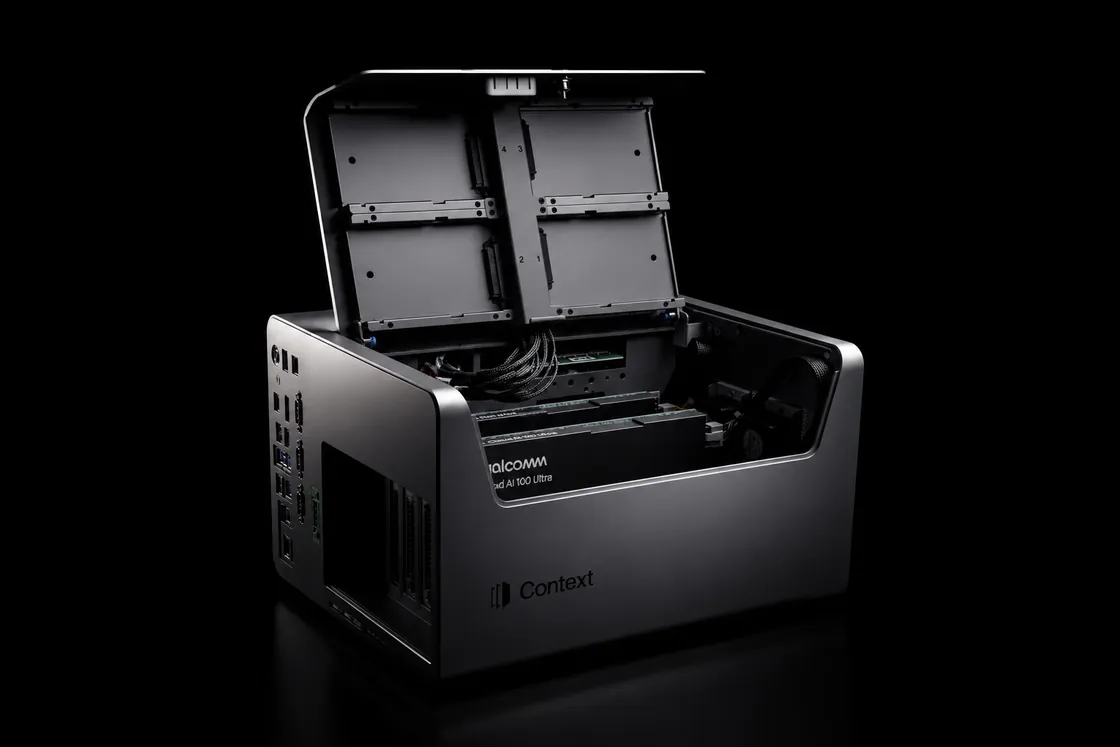
Hosted. Your VPC. Air-gapped. The on-prem Context appliance.
Use any model or agent.
Claude, GPT, Gemini, Kimi, or open weights. Bring your own agent framework, or use ours.
Enterprise-grade authorization.
Identity through your IdP. Customer-managed keys. Audit on every action. Permissions inherited at every connector call.



A complete working environment.
Documents, spreadsheets, decks, kanbans, and file viewers built in. Your team and agents work on the same files in the same environment.
Faster, cheaper, better
Custom models trained on your work
Your team's accepted outputs become training data for models you own and serve, and they beat general-purpose agents on your specific tasks.
Evals gate every change
Rubrics and golden sets validate every runbook, model, and context change against past work before it ships. Regressions are caught automatically.
Step-level model routing
Each step routes to the cheapest model that clears your rubric. Frontier models handle only the genuinely novel, so cost falls without losing quality.
Talk to us.
Bring a workflow your team runs today and see it run in your environment.